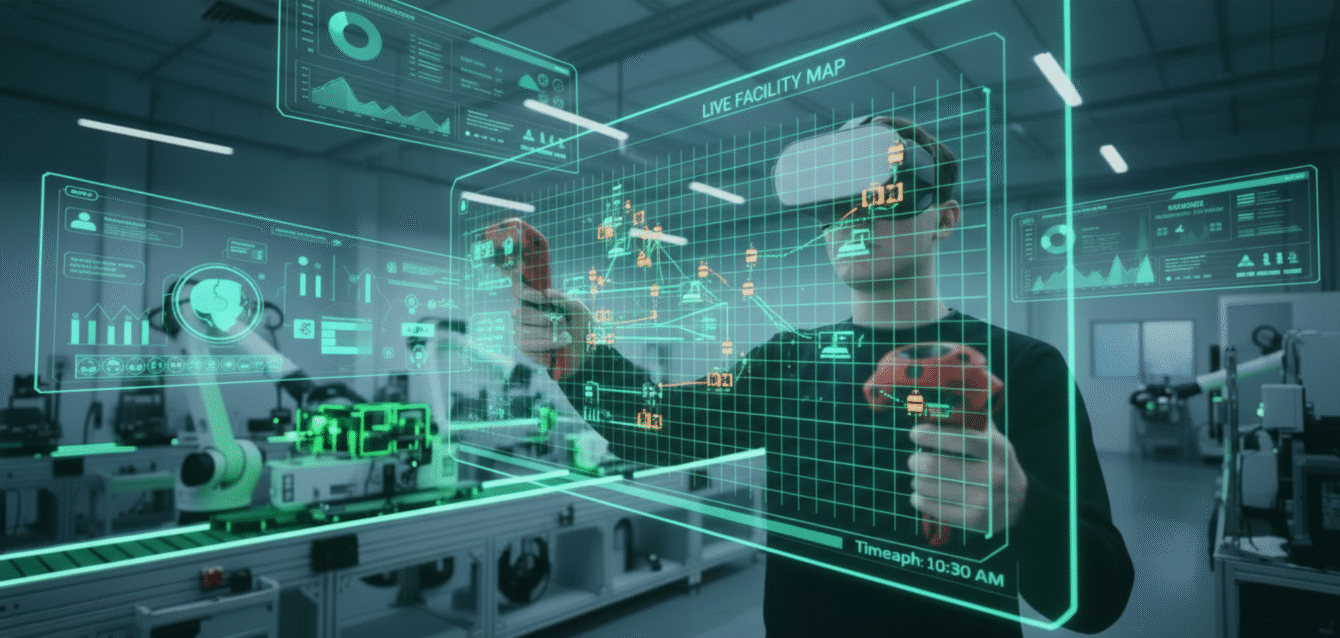
In expansive industrial settings—whether manufacturing halls, warehouses, logistics yards or multi‑level production zones—space is both a resource and a constraint. When layout, movement paths, storage zones, equipment placement and safety clearances are all managed with static drawings and manual measurements, inefficiencies creep in: hidden bottlenecks, under‑utilised cubic metres, unplanned dead zones, safety risks and unexpected costs. Enter LiDAR‑based spatial intelligence: by using laser pulses to map in high resolution the physical space and movement flows, facilities gain a live 3D/2D map of their assets, equipment, people and paths. This map isn’t just for visualisation—it becomes the operational core of planning, simulation, optimisation and safety.
By rethinking industrial space through the lens of spatial intelligence, operations move from reactive layout fixes to proactive, data‑driven transformation.
What LiDAR “Sees” That People and CCTV Often Miss
Human observation and traditional CCTV systems capture what is visible, but they struggle with depth, dimension, continuously changing layout and dynamic movement of equipment and people. By contrast, LiDAR (Light Detection and Ranging) uses laser pulses to precisely measure distances and produce dense point‑clouds of the environment, enabling 3D reconstructions of spaces, equipment, volumes and pathways. These scans reveal things human eyes overlook: the drop in clearance under a mezzanine, subtle drift in aisle widths, volumes of material piled in staging zones, or accumulation of pallets creating hidden hazards. This depth of perception means nothing hidden goes unnoticed.
Moreover, because LiDAR functions across lighting conditions and can deliver live scanning of moving objects, it supports both static mapping and dynamic monitoring. For example, it detects when a forklift passes an odd trajectory, when a stack creeps into a no‑go zone, or when path congestion builds behind the scenes. In short, LiDAR gives you the “what, where, when and how much” of your physical space—an underpinning for smarter operations.
How Live 3D/2D Mapping Helps Teams Plan Routes for People, Forklifts and AGVs
A warehouse or production floor is made up of people, vehicles, conveyors, forklifts, AGVs (Automated Guided Vehicles), storage racks and materials—all moving in complex choreography. Traditional planning often uses static drawings, fixed lane widths and assumed flows, which quickly become outdated as layouts or demand change. With LiDAR‑based spatial intelligence you obtain live 2D/3D maps that reflect current reality: actual widths of lanes, real turning radii, real travel time for forklifts or AGVs, and actual usage patterns of people. These maps empower teams to plan routes that avoid bottlenecks, reduce walking or driving distance, minimise interaction between people and vehicles, and optimise staging zones.
Further, this real‑time map supports simulation: what if a new line is added? What if a lane is converted to one‑way? What if high‑turnover SKUs are relocated? With virtual models built from LiDAR data, teams can test layout changes, validate labour flows, visualise forklift traffic and simulate future states. The result is fewer layout trials on the floor, faster changeover and smarter decision‑making based on spatial insights—not guesswork.
Eliminating Everyday Problems Like Blocked Aisles, Blind Spots, Narrow Turns, Dead Storage
Many industrial facilities live with recurring yet avoidable issues: aisles that get blocked by temporary staging, blind spots where forklifts meet people unexpectedly, narrow turns that slow AGVs or cause safety stops, or large zones of dead storage that hold little but occupy valuable cubic capacity. LiDAR spatial intelligence surfaces these problems without waiting for accidents or bottlenecks to happen. For example, scanning reveals that over time pallets creep into lanes, or that a storage zone’s usage has dropped to 20 % but still occupies 15 % of the floor. By flagging these issues early, teams can free up space, reassign lanes, widen frequent paths or eliminate under‑utilised storage.
The preventative benefit is operational as much as it is safety‑related. When you reconfigure lanes, reroute AGVs or assign staging zones based on real data, you reduce travel time, improve picking speeds, enhance throughput and reduce unexpected stops. LiDAR gives you the clarity to see what you weren’t seeing—and the opportunity to act before the problem becomes cost or incident.
How Precise Measurements and Grid Locations Make Layout Changes Faster and Less Risky
Changing a production layout is often risky—and slow—because it relies on physical measurements, human judgement and manual validation. Every change carries the risk of misalignment, unsafe clearance, broken workflows or equipment collision. With LiDAR‑based spatial intelligence, you gain precise measurement down to centimetres: exact aisle widths, bay heights, volume of stacks, proximity of equipment, and grid‑based locations for everything in the space. This allows engineers and planners to align layout changes virtually, check clearances, simulate AGV paths or forklift arcs, and produce actionable grid plans before any physical move.
That precision reduces change risk, drives faster decision‑making and cuts downtime. Instead of trial‑and‑error shuffling of racks or lanes, you move with confidence. You know the new layout will fit, the flows will align and safety margins are maintained. In effect, space planning becomes a high‑velocity capability rather than a slow, cost‑heavy exercise.
What Quick Wins Can Be Expected in 30‑60 Days
Once LiDAR spatial intelligence is deployed, many facilities observe visible improvements within 1‑2 months. Early wins might include smoother movement of vehicles and people, fewer near‑misses in intersections, higher throughput thanks to cleared lanes, improved storage density by reclaiming dead zones and quicker layout change cycles. These wins are as much about culture and trust as technology: once teams see accurate spatial data and act on it, momentum builds. By deploying the system in a critical zone—perhaps the busiest aisle or the staging area—and iterating layout changes based on scans, you generate proof points that drive broader adoption.
Additionally, you’ll often see measurable effects on travel time, picking cycle time, forklift queue length and space utilisation. Because the system uncovers previously invisible inefficiencies, those gains compound: every metre of travel saved, every bottleneck removed and every cleared zone increases throughput, reduces labour strain, and improves safety. 30–60 days is enough to shift from “we’re testing” to “we’re improving”.
Key Capabilities of a Live Spatial Intelligence System
A full‑featured spatial intelligence system built on LiDAR scanning and analytics brings together multiple capabilities:
Continuous 3D/2D mapping of the facility including racks, equipment and movement zones
Real‑time monitoring of vehicle and pedestrian movement including near‑miss detection
Historical movement heat‑maps for travel time, travel distance and bottleneck patterns
Simulation tools that allow “what‑if” layout testing without physical disruption
Integration with warehouse/production execution systems to trigger alerts or workflows on spatial anomalies
These capabilities turn static drawings into live operations dashboards, and reactive corrections into planned optimisations. With these tools in place, facility managers have the power to monitor and control space, flow and safety proactively.
From Mapping to Monitoring: The Role of LiDAR in Industry 4.0
Unlike a one‑time 3D scan which provides a snapshot, ongoing LiDAR‑based monitoring keeps the facility updated in real time, detecting changes, drift, zone creep, and evolving patterns. In the context of Industry 4.0, this live spatial data feeds into digital twins, facility dashboards and automation systems—enabling supply chains, warehouse floors and manufacturing cells to adjust dynamically. Alerts can trigger when a lane is blocked for more than a defined time, when stacking heights exceed safe limits, or when a vehicle route deviates. The closed‑loop cycle becomes: detect → alert → fix → verify via new scan.
Critically, this continuous monitoring ensures that layout improvements aren’t lost as operations change. It keeps built change under control, supports preventive maintenance, enables robotics and AGV navigation, and aligns physical space with digital operations. With LiDAR in place, industrial space becomes not just managed—but intelligently adaptive.
The Takeaway
LiDAR‑based spatial intelligence transforms industrial spaces from static assets into live, optimised ecosystems. By capturing precise 3D/2D maps, enabling route and flow optimisation, uncovering hidden inefficiencies, simplifying layout changes, delivering quick wins, providing rich capabilities and embedding continuous monitoring, facilities move from operating today’s space to engineering tomorrow’s. In the world of Industry 4.0 where agility and visibility matter, spatial intelligence is not optional—it’s foundational.