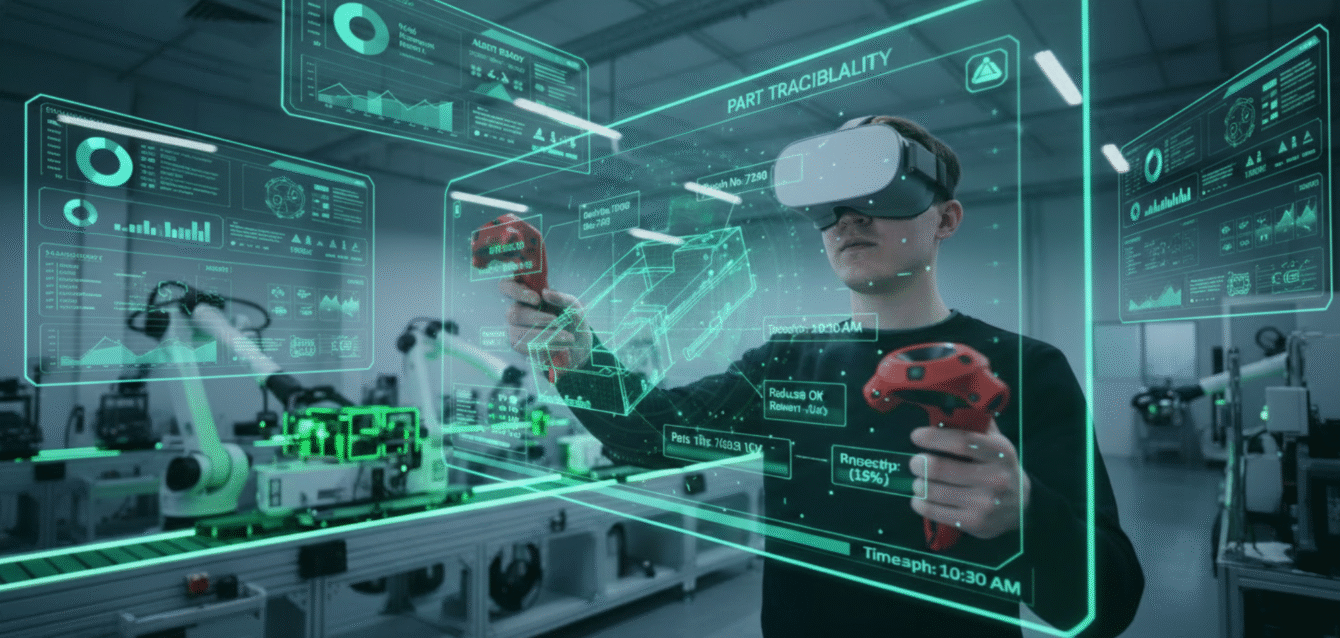
In today’s global manufacturing and logistics environment, parts move through dozens of processes—raw materials to suppliers, shipments across continents, production lines, warehouses, carriers, and final delivery. The sheer complexity creates blind spots: delays that don’t get flagged, parts that stray off route, quality issues that originate upstream yet manifest downstream. Traditional systems—manual logs, spreadsheets, static tracking—can’t keep pace. That’s why the convergence of AI (Artificial Intelligence) and IoT (Internet of Things) is reshaping traceability from a back‑office compliance tool into a live, strategic capability.
Together, these technologies give teams the visibility to see what’s happening right now and the foresight to act before small issues become big failures.
What IoT Devices Really Monitor—and Why It Matters
IoT devices—sensors, tag readers, connected machines and location trackers—are the tools that translate physical movement and status into data. In a complex supply chain, IoT not only sees where a part is, but when it left its prior station, how long it sat in transit, whether it passed the right inspection, and if it deviated from the planned route. For example, a sensor could flag that a pallet is sitting idle in the wrong zone, or that a temperature‑sensitive component has been exposed outside its safe range. These insights give you the what’s happening layer.
But data alone isn’t enough. That’s where AI adds value: by analysing the streams of IoT inputs, identifying patterns or deviations (for instance, a machine with a rising vibration that always coincides with a higher defect rate), and raising alerts proactively. In essence, IoT catches the signals—AI interprets them. Together they enable traceability to move from passive record‑keeping to real‑time action and prevention.
Connecting Suppliers, Production Lines and Logistics into One Flow
In many operations, traceability stops at the factory gate or warehouse threshold—once external suppliers or carriers kick in, tracking becomes fragmented and manual. A truly modern traceability system leverages both IoT and AI to link the entire chain: supplier deliveries, inventory movement, machine processing, internal logistics, outbound shipment. For example, if a supplier shipment is delayed, the system can flag that early, notify production planners, and adjust the schedule proactively. Or if a machine on the line begins processing parts outside acceptable tolerances, the system can trace back to the last moments of stocking or supplier batch to identify root cause.
What this does is create one continuous narrative—one that moves beyond silos and isolated systems. Instead of each link working in isolation, everyone sees the same thread of data: which parts came in, how they were processed, where they went, and when they should be delivered or inspected. This full‑chain visibility transforms traceability into both a protective and enabling tool—reducing delay, waste, risk, and improving coordination across teams.
Real‑World Savings and Risk Reduction from AI + IoT
The real value of AI and IoT in traceability is seen not just in better data—but in measurable business outcomes. Industries report fewer defective outputs when real‑time sensors and analytics detect process drift early or route deviations before shipment. In another case, logistics teams using GPS and RFID trackers caught rerouted pallets before downstream tasks were blocked, avoiding costly emergency sourcing. These improvements translate into stronger margins, fewer recall events, improved supplier reliability and better delivery performance.
Key benefits include:
- Reduced material waste and scrap
- Faster identification and isolation of deviations
- Higher on‑time delivery and lower logistics disruption
- Better supplier transparency and tighter hand‑off control
These benefits prove that integrating AI and IoT for traceability drives both resilience and competitive advantage.
Ensuring Secure, Scalable Traceability Across Multiple Sites
As traceability systems expand—from one site to many, from one line to global network—the issues of data access, security, and standardisation become critical. It’s not enough to collect data; you must protect it, control access, and ensure consistency. Role‑based permissions help: suppliers may only view their batches, production may see current status, quality may see defect history—but nobody sees more than they should.
Encryption, audit logs, and secure interfaces ensure that the system remains trustworthy and compliant. For multi‑site operations, this means establishing common standards so a deviation flagged in one plant has the same meaning and process as in another. When that foundation is in place, traceability scales from pilot to enterprise without losing governance or control.
What Results You Should Expect Within 60–90 Days
Even though AI + IoT traceability may seem like a long‑term investment, the first quarter often brings visible improvements. In many implementations, teams begin to see clearer visibility of parts’ movements, earlier warnings of bottlenecks or deviations, improved coordination between supplier and production teams, and fewer last‑minute firefights. Lead‑time variability drops, emergency sourcing falls, and defect‑linked delays begin to reduce. These early wins build confidence, justify further roll‑out, and convert traceability from an internal tool into a strategic asset.
The Takeaway
Traceability in today’s supply chains can no longer be reactive or piecemeal. With AI and IoT working together, it becomes live, connected and actionable. From suppliers to final delivery, materials and parts are constantly monitored, deviations are flagged before they become failures, and data flows seamlessly across teams and systems. The result? More resilience, fewer surprises, better quality, and stronger strategic control—turning traceability into an enabler of operational excellence.